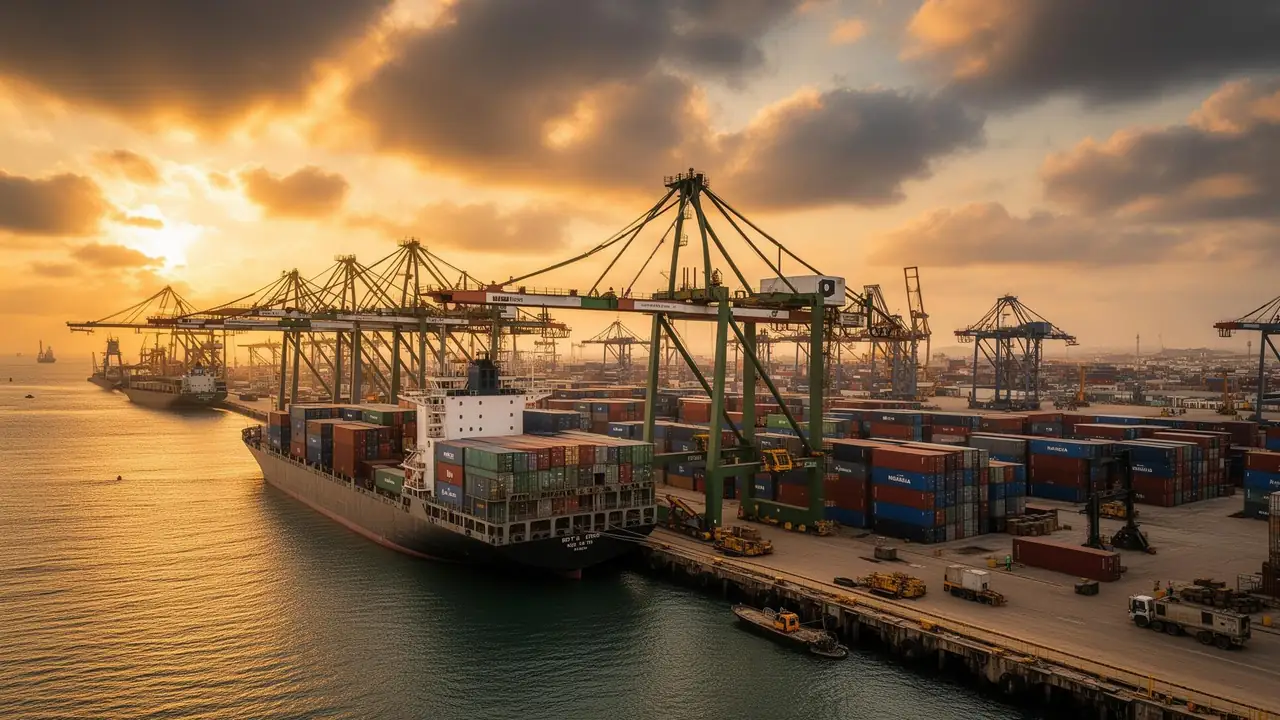
A container of imported machinery lands at a Nigerian port and sits there for three weeks. The goods are not damaged and the duty is calculable. The container is waiting for paperwork: a permit from one agency, an inspection slot from another, a document that has to be resubmitted because a number does not match.
Figures cited in DHL's guide to the system put the average at 18 to 21 days in Nigerian ports, against five to seven in Ghana and four in Benin. Vice President Kashim Shettima has said that Nigeria's dwell times exceed global benchmarks by 475%. Costs are reportedly about 30% higher than in neighbouring markets. The National Single Window, with phase one scheduled for 27 March 2026, is the government's answer.
How does paperwork become dwell time?
A shipment passes through several agencies before it is released. Customs assesses duty. The Standards Organisation of Nigeria checks conformity. NAFDAC reviews food and drug consignments. The port authority and maritime agency have their own requirements. Each has its own form, its own queue and its own sequence.
When these steps run one after another and none can see the others, a delay in one agency is invisible to the rest. The importer or its clearing agent learns of it only by asking. Every day of waiting adds demurrage and ties up capital in stock that has not been cleared. Much of this delay is administrative, which is why a system that connects the agencies can shorten it.
What does the Single Window actually change?
According to DHL, a trader lodges documents once, including the commercial invoice, packing list, permits and certificates, and the system routes them to the agencies concerned. Inspection becomes risk-based, so that only about 10% of shipments are examined physically. A trader can see which agency is handling a file at any moment. The system is planned to connect 35 locations across seaports, airports and land borders and to work with the African Continental Free Trade Area framework.
The stated targets deserve a careful reading. The National Single Window Secretariat says cargo clearance should fall from several weeks to 24 to 48 hours. DHL reports a goal of under seven days by the end of 2026. The two may measure different things, one the clearance step and the other the whole stay in port, but the published material does not say. Traders should plan against the longer figure until results are published.
What does it demand of traders?
A single submission is only an advantage if the submission is right. When every agency reads the same record, an inconsistency stops being a local problem that one officer might overlook and becomes a visible mismatch across the whole file. A product description that differs between the invoice and the permit, a tariff code that changes from one document to the next, or a certificate that has expired will all be caught earlier.
We read this as a shift in where effort goes. Under the old process, much of the work was chasing. Under the new one, the work is preparation: permits and registrations obtained before the ship arrives, product data held in one place, and documents checked against each other before they are lodged.
What should be watched?
The test is whether dwell time falls. Traders should track their own figures: the days from vessel arrival to release, split by agency where the system allows it. If published port statistics and their own records move together, the system is working. If their own records show a delay that the published figures do not, the problem sits with how their files are prepared, and that is the part within their control.
Executive Summary
The Paperwork Is the Cargo: What Nigeria's National Single Window Changes at the Port
Cargo in Nigerian ports waits 18 to 21 days, against five to seven in Ghana. The National Single Window targets the part of that delay caused by paperwork, and puts a premium on clean, consistent documents.
Ready to deploy resilient frameworks?
Engage our senior implementation team to translate diagnostic insights into highly functional operational architectures.