Nigeria is one of the largest producers of raw cashew nuts in the world. Large volumes are harvested every year across states such as Kogi, Kwara, Oyo, Ogun, and parts of the Middle Belt.
Yet despite this production strength, Nigeria captures only a fraction of the value that the global cashew industry generates.
Most of the country’s cashew exports leave as raw nuts, while the higher-value stages of processing and value addition take place elsewhere.
The issue is not production. Nigeria already produces significant volumes.
The issue is the structure of the value chain around that production.
The Raw Export Trap
For many years, Nigeria’s cashew sector has functioned largely as a raw commodity export industry.
Aggregators purchase raw nuts from farmers, assemble volumes through local buying networks, and export them to international processors, particularly in Asia.
Once exported, the nuts are processed, graded, packaged, and sold into global retail markets at significantly higher values.
This structure means that a large portion of the economic value associated with cashew processing is captured outside Nigeria.
The country participates in the early stage of the value chain but captures little of the value created further downstream.
Fragmented Sourcing Systems
One of the structural challenges within the Nigerian cashew sector is fragmented sourcing.
Farmers operate across dispersed production zones, often selling small quantities through informal trading networks.
Aggregators play an important role in assembling volumes, but these networks are often loosely organized and vary widely in terms of quality control and traceability.
For exporters, this creates challenges in maintaining consistent quality and verifying product standards across supply chains.
International markets increasingly require traceability and standardized grading systems. Fragmented sourcing environments make these requirements more difficult to achieve.
Limited Processing Infrastructure
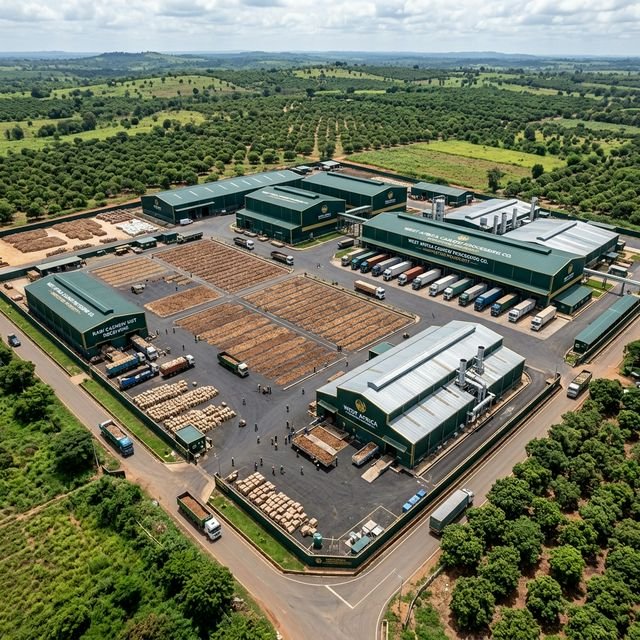
Another key constraint is the limited scale of domestic processing capacity.
While some cashew processing facilities exist within Nigeria, they remain relatively small compared to the scale of the country’s raw nut production.
Processing cashew nuts is capital intensive and requires reliable supply chains, skilled labor, and consistent power and infrastructure support.
Without sufficient processing capacity, exporters often find it more practical to sell raw nuts directly to established processing hubs abroad.
This reinforces the cycle in which Nigeria exports raw materials while value addition occurs elsewhere.
Quality and Handling Challenges
Post-harvest handling also affects the competitiveness of Nigerian cashew exports.
Storage conditions, drying practices, and grading procedures vary widely across production zones. Inconsistent handling can affect kernel recovery rates and overall product quality during processing.
International buyers pay close attention to these factors because they directly affect processing efficiency.
Without standardized post-harvest systems, maintaining consistent export quality becomes more difficult.
The Logistics Dimension
Export logistics also plays a role in shaping how the sector functions.
Moving large volumes of agricultural commodities through inland transport networks and into export terminals requires coordination between multiple actors.
Delays or inefficiencies at any stage can affect shipment schedules and increase operational costs.
For commodities like cashew, which operate on tight seasonal cycles, logistics reliability becomes particularly important.
Moving Toward a More Integrated Sector
Despite these challenges, Nigeria’s cashew sector still holds significant potential.
The country already has strong production capacity and established trading networks. With improvements in aggregation systems, post-harvest handling, processing infrastructure, and logistics coordination, the sector could capture a larger share of global value.
Building these capabilities requires viewing the sector not just as a production environment, but as a complete value chain system.
When sourcing networks are structured, quality standards are consistent, and logistics flows efficiently, the sector becomes far more competitive in global markets.
The Opportunity
Global demand for cashew products continues to grow.
Countries that develop integrated value chains — combining production, processing, and export systems — will be better positioned to capture that growth.
Nigeria already has the raw material base.
The next step is strengthening the systems that convert that production into higher-value participation in global trade.
Executive Summary
Why Nigeria's Cashew Sector Still Leaves Billions on the Table
Most of the country’s cashew exports leave as raw nuts, while the higher-value stages of processing and value addition take place elsewhere. The issue is not production, but the structure of the value chain.
Ready to deploy resilient frameworks?
Engage our senior implementation team to translate diagnostic insights into highly functional operational architectures.